 Written by
 HR Trends 2026 mark a decisive shift in how organisations must think about work, leadership, and people. The world of work is entering an era of permanent disruption, where geopolitical volatility, economic uncertainty, demographic shifts, and rapid advances in AI are converging to fundamentally reshape organisations and the role of HR.
This article forms the anchor of the HR Trends 2026 series on VHR Labs—an 18-part exploration of how HR must evolve from managing people to managing systems. Each article examines one critical shift shaping the future of work through a Four-System Leadership Framework.
In this environment, HR can no longer operate as a support function focused solely on managing people. It must evolve into a system that simultaneously interprets external forces, shapes business models, redefines work and employment, and reinvents itself to remain relevant in an AI-driven future of work.
As we step into 2026, it is becoming increasingly clear that the world of work is no longer experiencing change—it is living in a state of permanent disruption.
Geopolitical realignments, economic uncertainty, demographic shifts, rapid advances in AI, and evolving social expectations are converging to reshape organisations in ways we have not seen before. These forces are not episodic. They are systemic. And they are redefining what leadership—and especially HR leadership—must look like.
In many organisations, HR is still expected to “manage people.” But the reality is far more complex.
HR in 2026 can no longer afford to manage people in isolation. It must manage four systems simultaneously.
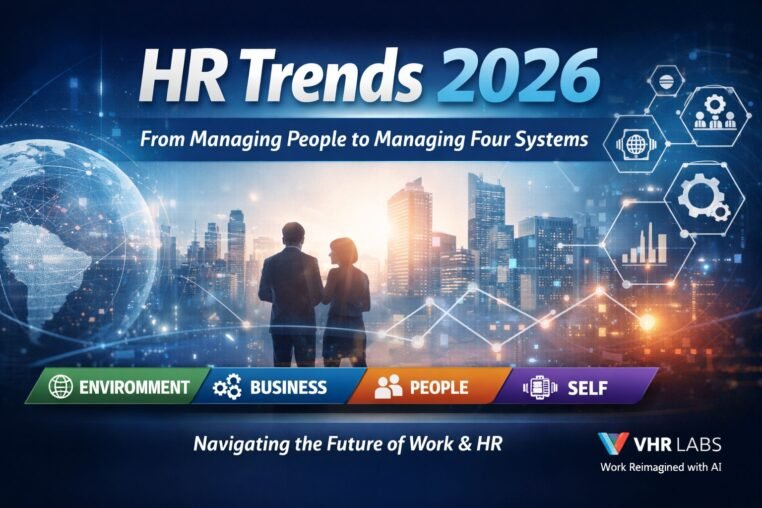
HR Trends 2026: A Four-System Leadership Framework
Based on research, practitioner insights, and real-world observation, I’ve developed a Four-System Framework to make sense of the forces reshaping HR and the workplace.

This framework helps HR leaders move:
- From inside-out to outside-in
- From functional excellence to systemic leadership
- From incremental change to intentional reinvention
1️⃣ Managing the Environment
Forces outside organisational control that fundamentally reshape work and talent
- Global Power & Demographic Shifts
- Globalisation Under Threat → Rise of GLOCAL
- Political & Policy Volatility
- Global Economic & Socio-Economic Stress
2️⃣ Managing the Business
Cost, operating models, structure, AI, and scalability
- Rising Costs & Inflation
- Cost-Led Workforce & Operating Models
- New Cost-Optimised Business Models
- Technology & AI as the Primary Business Accelerator
- Organisation & Structure Redesign
3️⃣ Managing People
Work, talent, skills, employment relationships, and experience
- Fragmentation of Work & Employment Models
- War on Talent & Loyalty Reset
- Job Architecture Disruption
- Continuous Skilling & Upskilling Imperative
- Return to Office: Expectation vs Mandate
4️⃣ Managing Self (HR’s Reinvention)
HR capability, identity, credibility, and operating model
- Digital Literacy as a Core HR Capability
- Rise of HR AI Agents & Automation
- The “Death of HR” vs Reinvention Debate
- HR as an Operating System for Work
Why This Framework Matters
What ties these 18 trends together is a simple but uncomfortable truth:
The future of HR will not be decided by how well it manages processes—but by how well it designs systems.
This thinking is deeply influenced by the intellectual lineage of HR thought leaders who have consistently challenged the profession to evolve—leaders such as Dave Ulrich , TV Rao , Marshall Goldsmith , Josh Bersin David Green , Nicolas BEHBAHANI each of whom, in different ways, has pushed HR beyond administration toward value creation, systems thinking, and strategic impact.
This framework does not replace their thinking. It synthesises and extends it for the realities HR faces heading into 2026.
These HR Trends 2026 highlight why HR must move beyond managing people to managing systems in an AI-driven world of work.
What’s Coming Next
This article is part of the HR Trends 2026 series on VHR Labs, where all 18 trends are being published and curated as a single body of work. You can follow the full series and each weekly deep dive under the HR Trends 2026 category on vhrlabs.com.
Over the coming weeks, I will publish one deep-dive every week—each focused on one of these 18 trends. Each post will explore:
- What is changing
- Why it matters
- What HR leaders should stop, start, and rethink
The goal is not prediction for prediction’s sake—but preparedness.
At VHR Labs , our mission is to help organisations and HR leaders reimagine work and augment HR capabilities—not replace them—using AI, digital tools, and human-centred design. We believe HR’s future lies in becoming an Operating System for Work, and technology should serve as an enabler of that transformation, not a distraction from it.
A Question to Leave You With
If volatility is permanent, AI is embedded into work, and employment itself is fragmenting…
Is your HR function still managing people— or is it ready to manage systems?
Follow along as we unpack this journey—one trend, one week at a time.
2 thoughts on “HR Trends 2026: Reinventing HR”