
 Written by
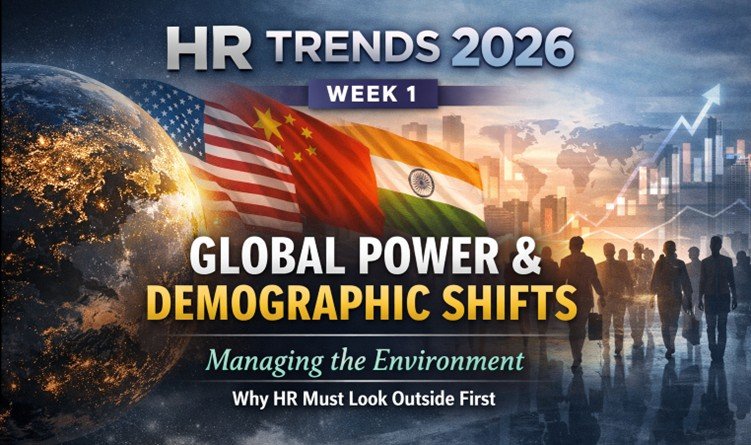
 Global power and demographic shifts are among the most significant external forces reshaping work and talent. As part of the ongoing HR Trends 2026 series, this piece examines one of the external forces reshaping work and talent—setting the context for how HR must respond in the years ahead.
If you have read the HR Trends 2026 pillar article, you will recall the central argument: HR can no longer start with people policies and work inward. It must start with the environment and work inward. Understanding forces outside organisational control is the essential first step in planning for the future of work.
Among all the forces reshaping work and talent, global power and demographic shifts are foundational. These forces are not a short-term cycle; they represent a structural realignment that will affect where work happens, where talent comes from, and how organisations must design capability.
The Big Shift: Global Power and Demographic Shifts
Economic momentum, demographic advantage, and workforce influence are shifting from long-standing Western centres toward emerging markets, particularly in Asia, Africa, and parts of Latin America. This redistribution challenges traditional workforce assumptions and requires HR to think beyond legacy paradigms.
Research from the OECD indicates that population ageing in developed economies is projected to significantly reduce the working-age population over the coming decades, placing pressure on labour supply and economic resilience.
Population projections also show that while global population growth slows, countries like India, Indonesia, and Nigeria will maintain relatively young and expanding workforces. In contrast, advanced economies are ageing rapidly, leading to structural labour constraints.
The World Economic Forum’s Global Human Capital Report highlights how demographic profiles are diverging sharply across regions, with many emerging economies expanding youthful labour pools while advanced economies face the risk of shrinking workforces.
For HR leaders, this means talent is no longer a homogeneous global commodity but a regionally differentiated resource.
Emerging vs Ageing Economies
Organisation strategies built around metropolitan Western contexts may miss the strategic value of emerging markets. For example, projections suggest that India’s demographic dividend will remain favourable through 2025–2035, even as China’s working-age population begins to contract.
In this context, HR is challenged not only by where talent exists, but by what talent expectations look like. Younger workers in emerging markets prioritise purpose, flexibility, digital fluency, and career mobility in ways that differ from more established markets.
The Rise of Hyper-Nationalisation and the End of Free Talent Mobility
Alongside demographic shifts, another powerful force is reshaping global workforce strategies: the rise of hyper-nationalisation.
Across many economies, immigration is no longer treated as an economic enabler but as a political and social fault line. Governments are tightening borders, revisiting visa regimes, and prioritising domestic employment in response to public sentiment, protectionism, and national security concerns.
Changing rules around skilled immigration—whether through evolving H-1B policies in the United States, revised points-based systems in Canada, or stricter localisation mandates in parts of Europe and Asia—are fundamentally altering how organisations access global talent. What was once a relatively fluid movement of skilled professionals is becoming selective, conditional, and uncertain.
For decades, multinational organisations leveraged global mobility as a strategic advantage—moving talent across borders to fill skill gaps, scale operations, and build leadership pipelines. That lever is no longer available with the same ease or predictability.
What This Means for Global Workforce Planning
For MNCs, this shift creates a new planning reality.
Global workforce strategies built on the assumption of seamless cross-border talent movement are increasingly fragile. Immigration constraints now introduce delays, costs, compliance risk, and—in some cases—complete infeasibility. As a result, organisations are being pushed to rethink where work gets done rather than where people are moved.
This accelerates a broader transition:
- From talent mobility to work mobility
- From expatriation to distributed delivery
- From global role portability to local capability building
The paradox is that while businesses remain global, workforces are becoming more localised.
The HR Imperative: Mitigating a Lost Advantage
For HR, this is not merely a compliance challenge—it is a strategic inflection point.
HR must move beyond relying on immigration as a workforce lever and instead design resilience into talent strategies. This includes:
- Building stronger local talent ecosystems rather than depending on imported skills
- Accelerating remote, hybrid, and near-shore models to access talent without relocation
- Investing in early capability development and reskilling to reduce dependency on external labour markets
- Partnering closely with business leaders to redesign roles around where work can be done, not where people must sit
In an era of hyper-nationalisation, the organisations that thrive will be those whose HR strategies assume restricted mobility as the default, not the exception.
This reinforces a central theme of HR Trends 2026: talent access volatility is now permanent, requiring workforce strategies designed for constraint—not convenience.
Changing Internal Geography of Work
Beyond global patterns, workforce distribution is shifting within countries. Improvements in digital infrastructure and the rise of hybrid and distributed work enable talent to thrive outside major metropolitan hubs. Data from the International Labour Organization shows evolving patterns of labour force participation and location, indicating that work is no longer attached to geographic centres alone.
This shift has practical implications for where organisations recruit, how they structure work, and how HR designs engagement and development practices.
Why This Matters for HR: The Outside-In Imperative
Understanding the environment is not an academic exercise; it is the essence of the outside-in approach that many HR thought leaders have advocated.
Dave Ulrich, a foundational voice in modern HR thinking, has long emphasised that HR must work from the outside in — starting with external stakeholders’ needs and context before designing internal systems. According to Ulrich,
“The outside-in approach says that HR work should start with the business context and stakeholder expectations, and only then move inside the organisation.”
This focus on external forces aligns with the work of Josh Bersin who highlights that HR must integrate data, systems, and workforce insight to respond to dynamic external realities rather than rely on static internal processes.
Moreover, thinkers like TV Rao have emphasised that context — socio-economic, cultural, demographic — must be central to any people strategy, particularly in diverse and emerging economies where talent dynamics differ from traditional norms.
John Boudreau a respected scholar on workforce strategy, has also argued that HR needs to think in terms of talent supply at scale, not just organisational demand — a perspective that resonates with macro demographic changes.
David Green 🇺🇦 known for his work in people analytics, underscores the importance of using data to interpret external signals and inform strategic decision-making
Nicolas BEHBAHANI a leader in strategic people analytics design, advocates for synthesising external data with enterprise systems to build agility into talent strategies
All of these perspectives point to the same truth: HR must broaden its field of view. If HR misreads external demographic and power shifts, every subsequent decision — from skills planning to career architecture — will be built on an unstable foundation.
What This Means for HR Leaders
These shifts quietly challenge some of HR’s most familiar assumptions:
- Talent is not evenly distributed across geographies.
- Workforce density and skill availability vary dramatically by region.
- Younger, digitally fluent workers have different expectations from those in ageing economies.
HR must develop location-aware workforce strategies that do more than exploit cost differentials. This involves anticipating where critical skills will emerge, understanding how workforce preferences vary culturally and economically, and designing practices that align capability with opportunity.
In practical terms, this requires:
- Rethinking workforce planning beyond global-city centric models.
- Designing reward, career, and development systems that work across diverse demographic contexts.
- Embedding demographic signals into leadership and capability decision-making.
Bringing It Back to the Bigger Picture
In the HR Trends 2026 pillar article, we highlighted that HR must manage four systems simultaneously: the Environment, the Business, People, and Self. This first deep dive into Global Power & Demographic Shifts illustrates why Environment must be addressed first.
If HR misreads the external landscape, every subsequent strategy — from skills and AI integration to culture and employee experience — may be misaligned with reality.
A Question to Leave You With
If demographic advantage and talent distribution are shifting… If hybrid and distributed work expand opportunities beyond geographic centres… If volatility is permanent, not cyclical…
Is your HR strategy still anchored in yesterday’s talent map?
Next week, we will explore how globalisation is giving way to “GLOCAL” realities — thinking globally while acting in tune with local contexts — and what it means for HR design and practice.
If this resonates, follow along. If it challenges you, even better — let’s keep the conversation going. At VHR Labs, our work focuses on helping HR leaders augment their capability — not just with digital tools and AI, but with lenses that make the world visible before designing the organisation.
One trend. One week. One step closer to HR as an operating system for work.
This article is part of an ongoing HR Trends 2026 series, where each week we explore one critical shift shaping the future of work and the role of HR. Every trend is discussed in depth and archived on VHR Labs as a single, evolving body of work. You can follow the full HR Trends 2026 series and read earlier articles via the HR Trends 2026 category on VHR Labs