
 Written by
 Global workforce strategy is no longer a matter of scale, efficiency, or global reach alone. In this week’s HR Trends 2026 deep dive on Global Power and Demographic Shifts, we explored how economic momentum, demographic advantage, and workforce availability are being redistributed across regions. These are not abstract macro trends; they are forces that directly reshape where talent comes from, how work is organised, and what HR must prioritise. As part of the HR Trends 2026 series, this article explores how global power shifts, demographic realignments, and geopolitical volatility are fundamentally reshaping how organisations access, deploy, and sustain talent.
One implication stands out clearly: the way organisations think about talent strategy must fundamentally change.
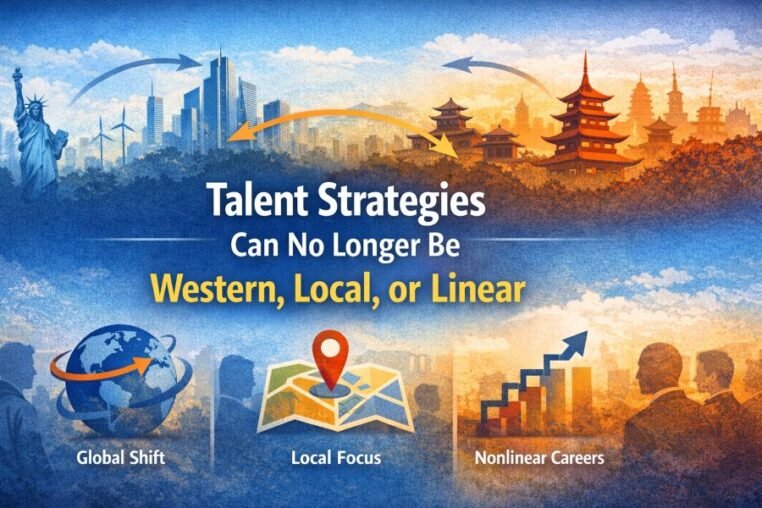
Talent strategies designed for a Western-centric, globally mobile, and linear world are increasingly misaligned with reality. The environment HR is operating in today demands a different logic altogether.
The Context Has Shifted — Quietly but Structurally
For much of the last three decades, talent strategy rested on a stable set of assumptions. Growth was concentrated in developed economies. Skilled talent could move across borders with relative ease. Careers followed predictable, upward paths.
Those assumptions no longer hold.
Why Global Workforce Strategy Must Be Designed Outside-In
Demographic advantage is shifting toward emerging economies with younger, expanding workforces. At the same time, political and policy volatility is restricting cross-border mobility. Work itself is becoming less tied to physical location, even as employment regulations become more nationally anchored.
As Dave Ulrich long argued, HR effectiveness begins with an outside-in understanding of context. When the external environment changes this dramatically, internal people practices cannot remain static.
Why Global Workforce Strategy Must Change Now

Why Talent Strategies Can No Longer Be Western
Many talent frameworks still reflect Western norms — in how careers are designed, how leadership potential is defined, and how motivation is understood. Yet the fastest-growing workforce populations today are in regions with different socio-economic realities, aspirations, and constraints.
Younger professionals in emerging markets often prioritise employability, flexibility, digital fluency, and mobility of opportunity over traditional notions of tenure or hierarchy. Designing talent strategies purely through a Western lens risks misreading both capability and intent.
As Lynda Gratton has observed, the future of work is shaped as much by geography and culture as by technology. Talent strategy must therefore become context-aware, not culturally assumed.
This shift demands a global workforce strategy designed for constraint, localisation, and volatility rather than seamless mobility.
Why Talent Strategies Can No Longer Be Merely Local
Paradoxically, while talent pools are global, access to them is becoming more localised. Immigration constraints, localisation mandates, and geopolitical uncertainty are forcing organisations to rethink long-standing mobility assumptions.
For decades, global mobility was a strategic lever — a way to move skills where they were needed. That lever is now constrained by default. This shifts the focus from moving people to moving work.
Here, John Boudreau‘s work on workforce ecosystems becomes especially relevant. Talent strategy can no longer be confined to organisational boundaries or national borders; it must integrate local labour markets, education systems, partners, and platforms into a broader supply model.
Local talent strategies that ignore global interdependence become fragile. Global strategies that ignore local constraints become impractical.
Why Talent Strategies Can No Longer Be Linear
Perhaps the most profound shift is the collapse of linear career logic.
Skills now have shorter shelf lives than roles. Career paths are increasingly non-sequential, with lateral moves, reinvention cycles, and learning loops becoming the norm. This is not a generational preference; it is a structural response to the pace of change.
Business leaders like Satya Nadella have repeatedly emphasised the importance of learning mindset over fixed expertise. From an HR perspective, this means moving away from static job architectures and toward capability-based systems that allow talent to evolve continuously.
Linear workforce planning in a non-linear world creates risk, not stability.
What This Means for HR Leaders
Taken together, these shifts challenge some of HR’s most familiar practices.
Talent can no longer be assumed to be evenly distributed across geographies. Workforce planning must become location-aware rather than headquarters-driven. Career and reward systems must function across diverse demographic contexts. Learning must be designed as an ongoing system, not an episodic intervention.
Most importantly, HR must design for constraint, not convenience. Mobility limits, demographic imbalance, and volatility are not temporary disruptions; they are permanent conditions.
Bringing It Back to HR Trends 2026

The HR Trends 2026 framework argues that HR must manage four systems simultaneously: the Environment, the Business, People, and Self. This week’s focus on Global Power and Demographic Shifts reinforces why Environment must be addressed first.
If HR continues to design talent strategies for a world of frictionless mobility, demographic stability, and linear careers, every downstream decision — from skills planning to AI integration — will rest on an outdated foundation.
The environment has changed. Talent strategy must change with it.
A Closing Reflection
HR leaders who rethink global workforce strategy through an outside-in lens will be better positioned to build resilience in an era of permanent disruption.
If demographic advantage is shifting… If work is becoming detached from place… If mobility is constrained and careers are fluid…
Is your talent strategy still anchored in yesterday’s assumptions?
At VHR Labs, our work focuses on helping HR leaders strengthen this outside-in lens — integrating environmental awareness with business design, people strategy, and digital capability. Not to chase trends, but to build workforce systems resilient enough for the realities ahead.
This piece is part of the ongoing HR Trends 2026 series — one trend, one week — as we move closer to HR functioning as an operating system for work.
Test