
 Written by
 Artificial Intelligence may be the most transformative force of our lifetime.
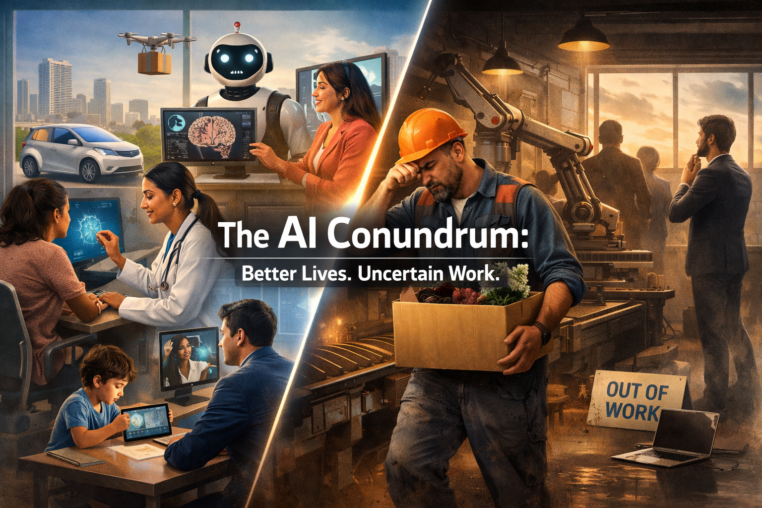
For consumers, AI is already delivering faster services, better quality, and lower costs. For workers, it raises a deeper question: what happens when intelligence itself becomes automated?
This tension is the AI Conundrum.
The Consumer Wins
AI is reshaping everyday life.
In education, adaptive AI tutors personalize learning at scale. In healthcare, AI-assisted diagnostics improve early detection and accelerate drug discovery. In customer care, intelligent agents resolve queries instantly, 24/7. Across daily life, AI optimizes schedules, recommendations, logistics, and workflows.
Over time, AI will reduce friction across nearly every sector — improving speed, precision, and affordability.
It is no surprise that leaders like Sundar Pichai describe AI as more profound than electricity or fire. Its impact is foundational.
From a consumer standpoint, this is progress.
The Workforce Shock
But the same efficiency that delights consumers disrupts workers.
The McKinsey Global Institute estimates that up to 30% of work activities could be automated by 2030, particularly routine and predictable tasks. The World Economic Forum similarly projects large-scale job displacement alongside new job creation.
This connects directly to the bottom of the value-chain pyramid — roles built on:
- repetitive execution
- standardized workflows
- rule-based decisions
- low skill differentiation
AI is not just replacing manual labor. It is automating routine cognitive work.
Even optimists like Peter Diamandis acknowledge that exponential technologies create long-term abundance but can produce short-term disruption. Elon Musk has warned that AI may outperform humans in most economically valuable tasks, potentially requiring new economic models. Sam Altman believes entire job categories will disappear — but new ones will emerge that we cannot yet imagine.
Both views can be true.
That is the conundrum.
Start With Value, Not Technology
This is where HR Guru Dave Ulrich offers an important reframing. He argues that
AI is not the goal — it is a means to create value.
Too many organizations are tool-driven: “Let’s implement AI because it exists.”
Ulrich challenges that thinking. Start with stakeholder value — customers, investors, communities — and then ask how AI helps deliver measurable outcomes.
If AI improves efficiency but does not improve stakeholder value, it is not transformation. It is experimentation.
This perspective reframes the AI conversation entirely.
The question is not, “Where can we apply AI?” The question is, “What value must we create — and how can AI help us create it?”
Hybrid Intelligence: The Real Advantage
Ulrich also emphasizes the idea of hybrid intelligence — AI × Human Ingenuity.
AI increases efficiency. AI synthesizes data. AI accelerates knowledge.
But humans provide:
- interpretation
- ethical judgment
- emotional intelligence
- contextual decision-making
- meaning
Competitive advantage will not come from AI alone. It will come from how well organizations combine AI capability with human capability.
AI will replace some tasks and some jobs. That is inevitable. But more importantly, it will change the nature of work.
Routine work will shrink. Uniquely human work will expand.
Organizations that proactively redesign roles so humans focus on creativity, collaboration, empathy, and strategic thinking will thrive.
Those that simply automate without redesigning will struggle.
The Bigger Risk: Inequality
Institutions like the IMF and OECD warn that AI could widen income inequality if productivity gains concentrate among capital owners and highly skilled talent.
Consumers may benefit from lower prices. But displaced workers may struggle to transition quickly.
If the transition is mismanaged, inequality and social unrest could follow. If managed well, work could evolve upward in value.
The outcome is not predetermined.
It depends on leadership.
The AI Conundrum is not just a technology issue. It is a workforce architecture issue.
If 30% of tasks can be automated, organizations must:
- Move from job-based structures to skill-based models
- Shift from episodic training to continuous reskilling
- Redesign performance systems around adaptability
- Protect employee experience during automation
- Align AI to measurable stakeholder value
This is also where ecosystems like Virtual HR Labs become relevant — not as technology vendors, but as platforms for rethinking work.
Whether through virtual HR advisory conversations on workforce redesign, experience-at-work frameworks that help protect engagement during automation, peer communities where leaders exchange real lessons on AI transitions, or structured reskilling initiatives that prepare teams for hybrid roles — the focus must remain on redesigning work, not just deploying tools.
Because AI implementation is easy. Work redesign is hard.
And that is where the real transformation lies.
Will the Gains Be Greater Than the Pains?
AI will improve lives. That seems inevitable.
Whether it improves livelihoods depends on how intentionally we redesign work around hybrid intelligence and stakeholder value.
The AI Conundrum is not about humans versus machines.
It is about whether leaders can ensure machines amplify human value — not erode it.
AI is not the future of work. Hybrid intelligence is. The organizations that design work where AI creates efficiency and humans create meaning will define the next era.
That is the real AI Conundrum. And the real opportunity.