 Written by
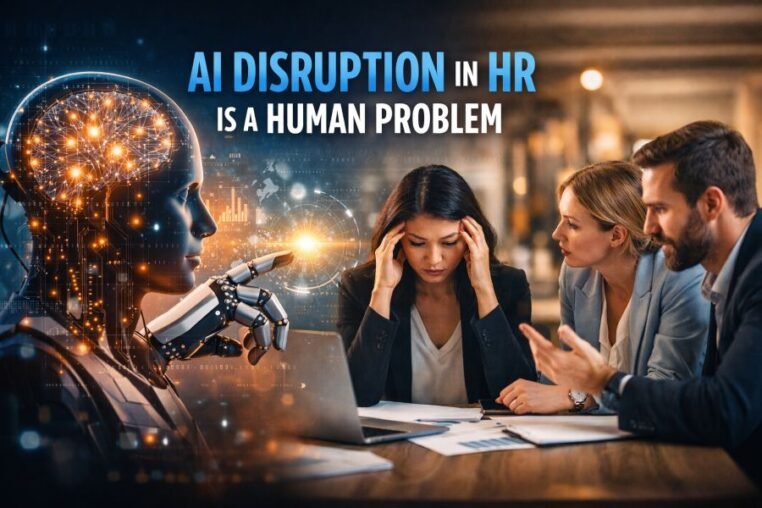
 AI Disruption Is Not a Technology Problem. It’s a Human One
Introduction: The Wrong Question We’re Asking
Everywhere you look, leaders are asking the same question:
“How do we adopt AI faster?”
But that question itself reveals the problem.
AI disruption is not primarily a technology challenge. It is a human, organisational, and leadership challenge. Technology is moving fast—but people, mindsets, work design, and capability models are not keeping pace.
This growing mismatch is what’s creating fear, resistance, confusion, and ineffective AI adoption across organisations.
Context: Why AI Adoption Is Struggling
Despite massive investments in AI tools, platforms, and automation:
- Many AI initiatives stall after pilots
- Employees resist or underutilise tools
- Leaders struggle to explain why AI is being introduced
- HR functions feel pressured but underprepared
Research consistently shows this gap:
- McKinsey reports that while over 70% of companies experiment with AI, only a small fraction scale it successfully.
- Gartner highlights that culture, skills, and change readiness—not technology—are the biggest barriers to AI value creation.
- MIT Sloan research emphasises that AI success depends more on how work is redesigned than on the sophistication of algorithms.
The conclusion is clear: AI disruption is fundamentally about humans and work, not machines.
The Real Nature of AI Disruption in HR and Work
AI doesn’t disrupt organisations by replacing people overnight.
It disrupts them by exposing outdated assumptions about:
- Jobs and roles
- Decision-making authority
- Skills and career paths
- The role of HR as a business partner
In many organisations, work is still designed for a pre-AI world:
- Linear processes
- Static job descriptions
- Human-only decision models
- Compliance-focused HR operating models
AI simply makes these limitations visible—and unsustainable.
Why This Is a Human Problem (Not a Technology One)
1. Fear and Identity Threat
For many professionals, AI triggers a deep identity question:
“If a machine can do part of my job, what is my value?”
This fear cannot be solved with more dashboards or tools.
It requires psychological safety, reskilling, and reframing of roles—areas where HR and leadership play a critical role.
2. Skills Are Lagging Behind Technology
AI tools are increasingly intuitive.
Human skills—especially sense-making, judgment, ethics, collaboration, and adaptability—are not being developed at the same pace.
This creates a paradox:
- Technology becomes smarter
- Humans feel less confident
AI fluency is not just technical literacy—it is contextual and behavioural capability.
3. Work Has Not Been Redesigned
Most organisations attempt to “layer AI” onto existing work instead of redesigning work for AI.
Without rethinking:
- Task allocation (human vs AI)
- Decision rights
- Accountability
- New role archetypes
AI adoption remains superficial.
This is where Digital HR must move beyond automation into work and organisation design.
What This Means for HR Leaders and HR Business Partners
The traditional HR Business Partner model is under pressure.
In an AI-driven environment, HR’s role must evolve from:
- Process owner → Capability architect
- Policy enforcer → Human experience designer
- Support function → Strategic sense-maker
HR leaders who succeed in the AI era will focus on:
- Building AI-ready human capability
- Redesigning roles and workflows
- Helping leaders make better decisions with AI
- Creating continuous learning ecosystems
This is exactly where Digital HR transformation becomes meaningful—not as a toolset, but as a mindset shift.
From Tools to Thinking: The Role of Virtual HR Advisors
One of the most promising developments in this space is the emergence of Virtual HR Advisors and AI Agents for HR.
When designed well, these:
- Augment human judgment (not replace it)
- Provide contextual guidance to managers and employees
- Democratise access to HR insight
- Free HR professionals to focus on higher-value human work
At VHR Labs, this philosophy underpins how we think about AI-enabled HR advisory—technology serving people, not the other way around.
(Internal link suggestion: Virtual HR Advisor page)
Why Community Will Matter More Than Ever
No individual, role, or function can navigate AI disruption alone.
This is why communities of practice and learning are becoming critical:
- People learn faster together
- Shared experiences reduce fear
- Collective intelligence outperforms isolated expertise
The future of work will belong to open, cross-domain learning communities, not closed silos.
This belief is what led to the creation of the VHR Community—a free, domain-agnostic space where professionals can:
- Connect
- Share experiences
- Learn how to stay relevant in an AI-first world
(Internal link suggestion: VHR Community page)
Key Takeaways (For Leaders and Professionals)
- AI disruption is primarily a human challenge
- Technology adoption fails when work, skills, and mindsets don’t evolve
- HR has a pivotal role in redesigning work for the AI era
- Virtual HR Advisors can augment—not replace—human capability
- Communities will become the new infrastructure for learning and relevance
A Powerful Conclusion: The Choice Ahead
AI will continue to advance—whether organisations are ready or not.
The real question is not:
“How fast can we deploy AI?”
But:
“How well are we preparing humans to work with it?”
Organisations that treat AI as a technology project will struggle.
Those that treat it as a human transformation journey will thrive.
If you’re grappling with AI disruption—as a leader, HR professional, or individual contributor—you don’t have to navigate it alone.
👉 Join the VHR Community (Free) — a growing, open platform where professionals come together to learn, share, and stay relevant in an AI-first world.
At VHR Labs, we are also exploring how Virtual HR Advisors and Digital HR models can support organisations in redesigning work and human capability for the future.