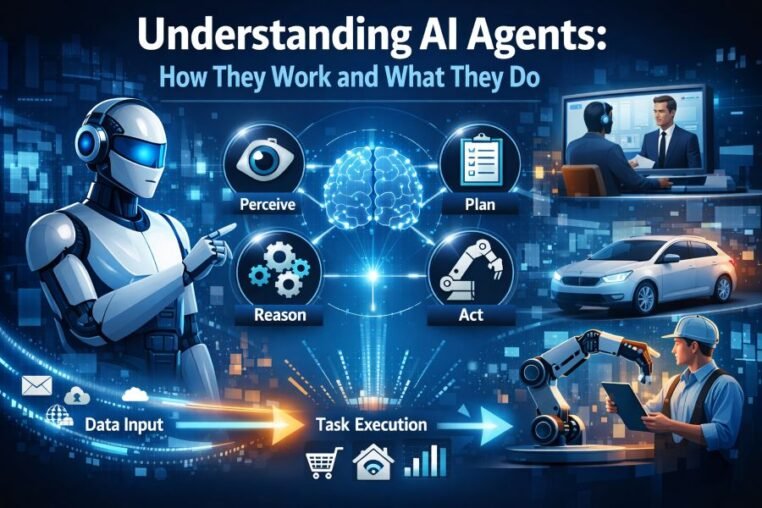
 Written by
 AI Digital Coworker is no longer a futuristic concept—it is rapidly becoming a workplace reality. Most organizations still treat AI as a productivity tool used to automate tasks or generate outputs. As we move toward 2026, this mindset is proving insufficient. The real shift lies in reimagining AI not as software in the background, but as a digital coworker that actively collaborates with humans to deliver outcomes.
What is Artificial Intelligence (AI)?
Artificial Intelligence (AI) refers to the ability of machines or software systems to simulate human intelligence.
AI systems can learn from data, recognize patterns, reason, make decisions, and improve over time.
In simple terms:
AI enables machines to think, learn, and act intelligently—without being explicitly programmed for every situation.
Examples of AI in daily life
- Google Search and Maps
- ChatGPT and voice assistants
- Recommendation systems (Netflix, Amazon)
- Fraud detection in banking
- Face recognition and spam filters
What is an AI Agent?
IBM defines AI Agents as An artificial intelligence (AI) agent is a system that autonomously performs tasks by designing workflows with available tools.
An AI Agent is an autonomous intelligent system that can:
- Perceive its environment
- Reason and decide what to do
- Take actions to achieve specific goals
- Learn and improve from feedback
Unlike traditional AI models that only respond to prompts, AI Agents can act independently, interact with tools, APIs, and even collaborate with other agents.
Think of an AI Agent as a “digital employee” that can observe, think, decide, act, and learn.
Example AI Agents
- A chatbot that books meetings and sends emails
- An HR agent screening resumes and scheduling interviews
- A Personal Professional Trainer agent that is always-available learning & development partner at the workplace
- A customer support agent resolving tickets automatically
- A trading bot making buy/sell decisions
AI Digital Coworker: How AI Agents Actually Work
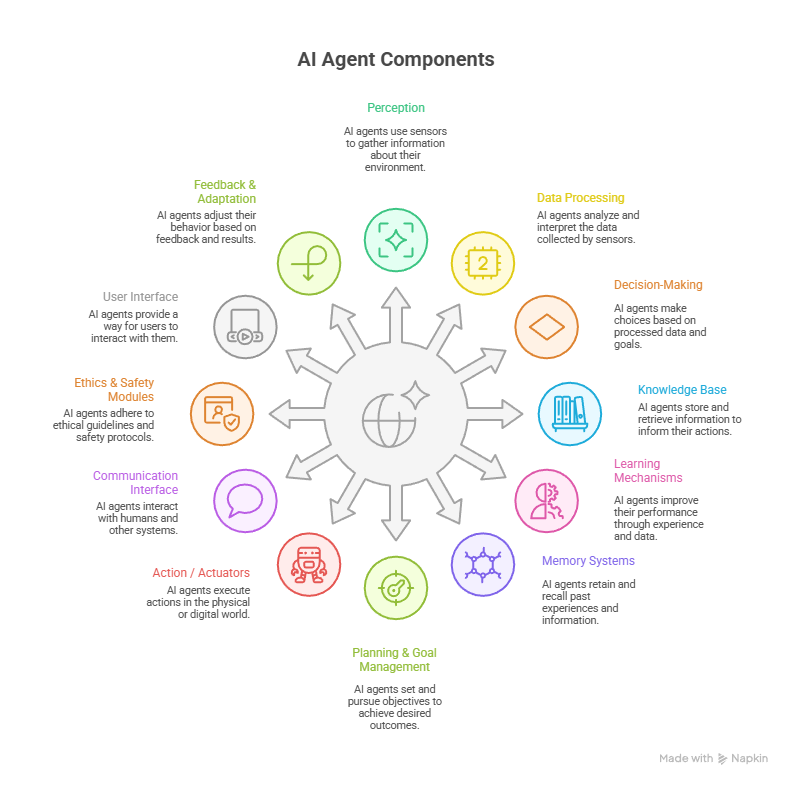
1. Perception / Sensors
- Collects data from inputs such as:
- Text, voice, images
- Cameras, microphones
- APIs, databases
- Detects changes in the environment in real time
Example: Reading a user’s query or fetching live data from a website
2. Data Processing Modules
- Converts raw data into usable formats
- Cleans noise and extracts meaningful features
Example: Converting speech to text or summarizing long documents
3. Decision-Making Engine
- The “brain” of the AI Agent
- Uses:
- Rules
- Machine learning models
- Neural networks
- Reinforcement learning
Example: Deciding whether to approve a request or escalate it
4. Knowledge Base
- Stores structured and unstructured knowledge
- Includes:
- Databases
- Knowledge graphs
- Documents and policies
Example: HR policies, FAQs, company data
5. Learning Mechanisms
- Helps the agent improve over time
- Learns from:
- Historical data
- User behavior
- Feedback
Example: Improving responses based on user ratings
6. Memory Systems
- Short-term memory: recent conversations
- Long-term memory: user preferences, history
Example: Remembering a user’s role or past interactions
7. Planning & Goal Management
- Breaks large tasks into smaller steps
- Optimizes execution and resource use
Example: Planning a multi-step onboarding process
8. Action / Actuators
- Executes actions in the real world or digital systems
- Uses APIs, workflows, or robotic systems
Example: Sending emails, updating CRM, booking calendar slots
9. Communication Interface
- Enables interaction via:
- Text
- Voice
- Chat
- APIs
- Supports collaboration with other agents
Example: Chat interface or voice assistant
10. Ethics & Safety Modules
- Ensures responsible AI behavior
- Handles:
- Bias prevention
- Data privacy
- Compliance
- Risk mitigation
Example: Preventing misuse or unethical decisions
11. User Interface (UI/UX)
- Makes the AI Agent easy and intuitive to use
- Includes dashboards, chat windows, voice UI, AR/VR
Example: A clean chatbot interface or admin dashboard
12. Feedback & Adaptation Loop
- Collects feedback from users and outcomes
- Refines decisions and improves performance
Example: Learning from failed responses and correcting them
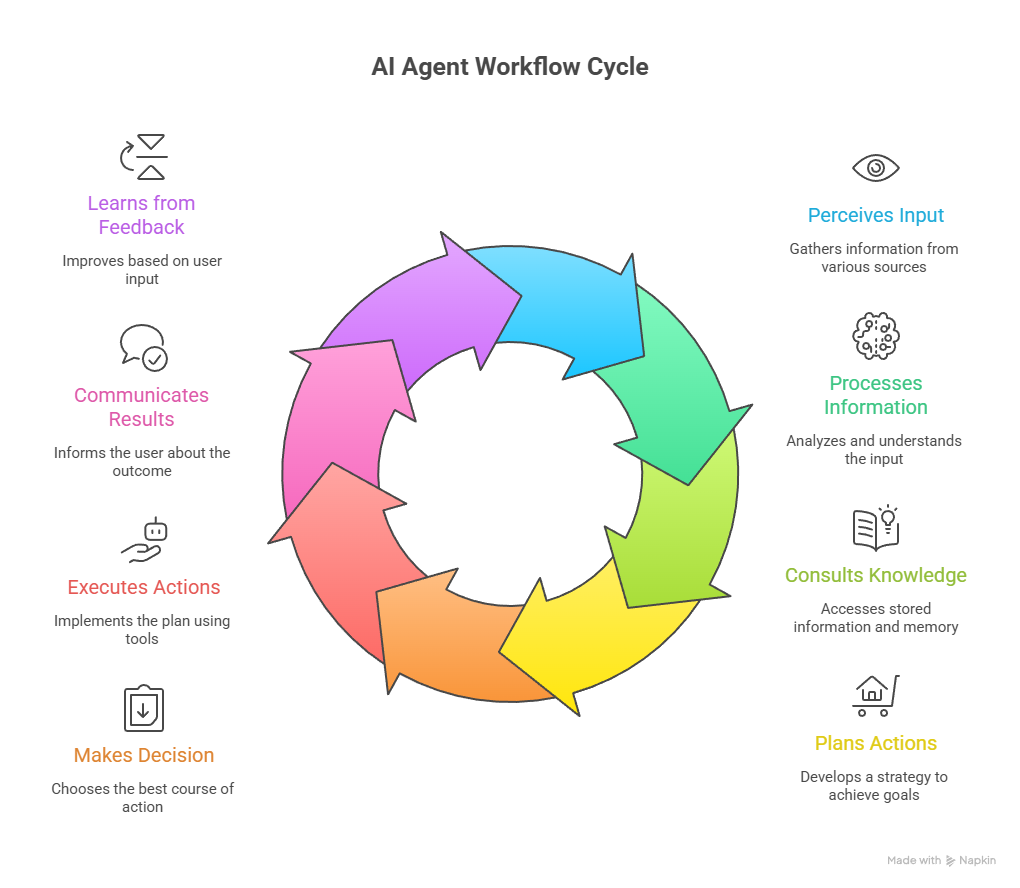
How Does an AI Agent Work? (Simple Flow)
In One Line
- AI = Intelligence in machines
- AI Agent = AI that can autonomously observe, decide, act, and learn
- Key Components = Sensors + Brain + Memory + Actions + Learning + Ethics
- Outcome = Scalable, intelligent digital workers
Frequently Asked Questions
What is an AI agent?
An AI agent is an autonomous software system designed to perceive its environment, reason about information, make decisions, and take actions to achieve specific goals. Unlike traditional software, an AI agent can operate independently, learn from interactions, and adapt its behavior over time.
How do AI agents work?
AI agents work through a continuous cycle of perception, reasoning, planning, and action. They collect data from their environment, analyze it using machine learning and reasoning models, decide on the best course of action, and then execute tasks using digital tools or systems. Feedback from these actions helps the agent improve future decisions.
How are AI agents different from traditional AI tools?
Traditional AI tools respond to direct commands and perform predefined tasks. AI agents, on the other hand, are goal-driven and proactive. They can plan multiple steps, coordinate with other systems, and operate with a degree of autonomy, making them more like digital coworkers than simple automation tools.